How a team assembles - and hires - around one business
One question in, four deliverables out, and a new specialist hired the moment the work demanded one. A walkthrough of what an orchestrated AI team actually does.
When people say they have "added AI" to their business, they usually mean one thing: a chat window. A single assistant, in a single box, that answers when spoken to and forgets when the tab closes. It is useful. It is also nothing like having a team.
A real team works differently. You bring a problem, not a prompt. The right specialist picks it up. When the problem turns out to need three more people, they get pulled in - and when it needs an expertise nobody on the team has, someone goes and finds that person. You stay in the chair that matters: deciding. Everyone else does the work.
That is the difference we keep trying to explain, so we built a walkthrough that shows it instead. Meet Lumen & Co. - a fictional sustainable-homeware brand, invented purely to demonstrate the mechanic. Every number below is made up. The way the team behaves is not.
It starts with a sentence
Lumen's founder doesn't write a brief or book a workshop. They ask one question: "Who are we actually up against in the UK, and where is there room to win?"
Lennox, the research specialist, picks it up and returns a competitive landscape scan the same day. The market sized. Five competitors profiled. A positioning map with one quadrant marked in teal - premium and independently verified - that nobody currently owns. Crucially, every figure is labelled by how solid the evidence behind it is, so the founder can see exactly which numbers to lean on and which to treat as directional.
Lennox didn't appear from nowhere. Before this story began, he was built the way you're about to watch Fern be built - given the context to reason inside a market like this one, shown what a strong scan looks like, and bound by hard rules against stating anything the evidence won't support. That is why one sentence is enough to set him to work: the hard part happened before you typed it.
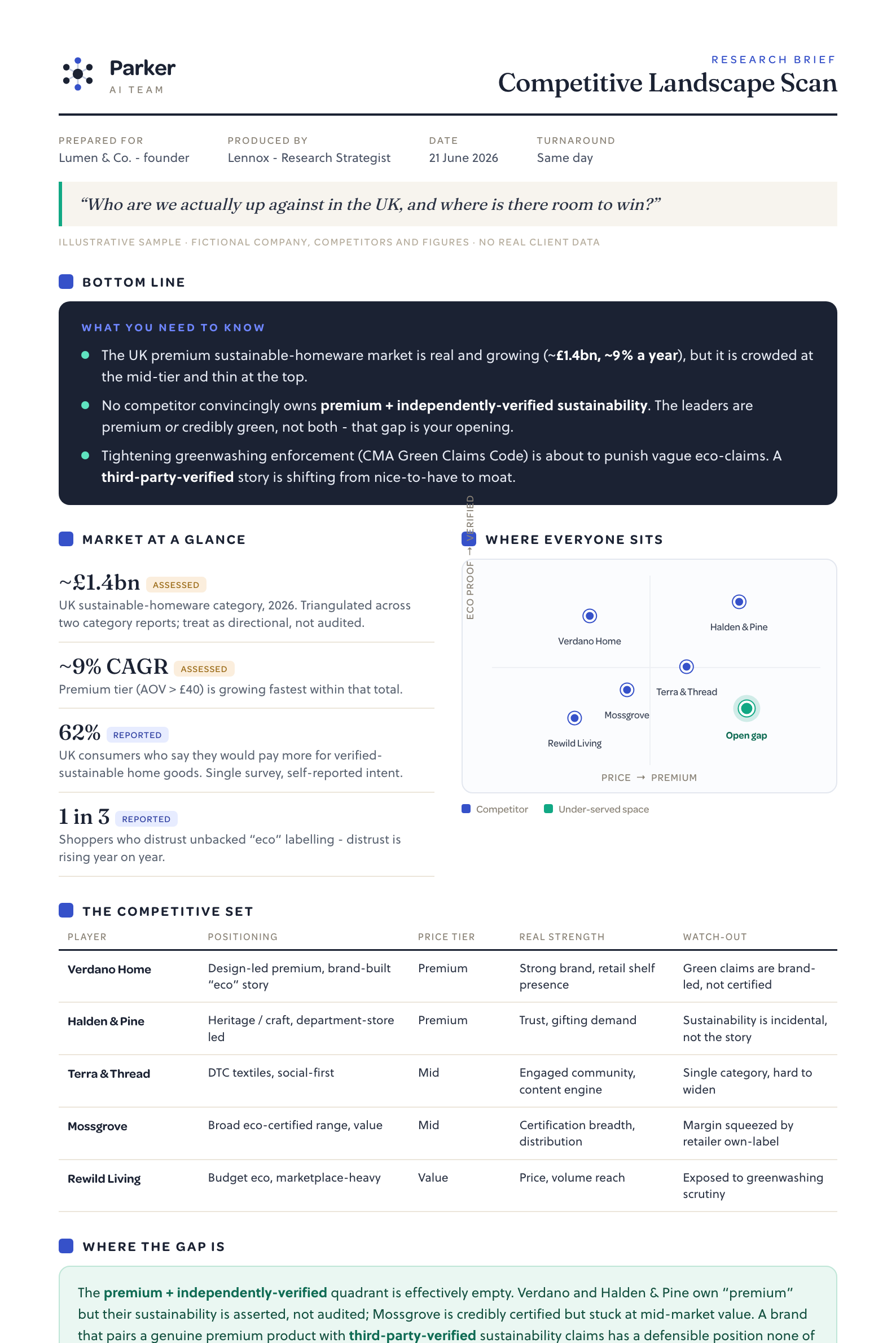
This is already more than a chatbot gives you. It is not a wall of text to read and interpret. It is a decision-grade document, sourced and structured, that points at an answer.
When one answer isn't enough
The scan found a gap, so the founder asks the obvious follow-up: "Should we actually go for it - premium and verified?"
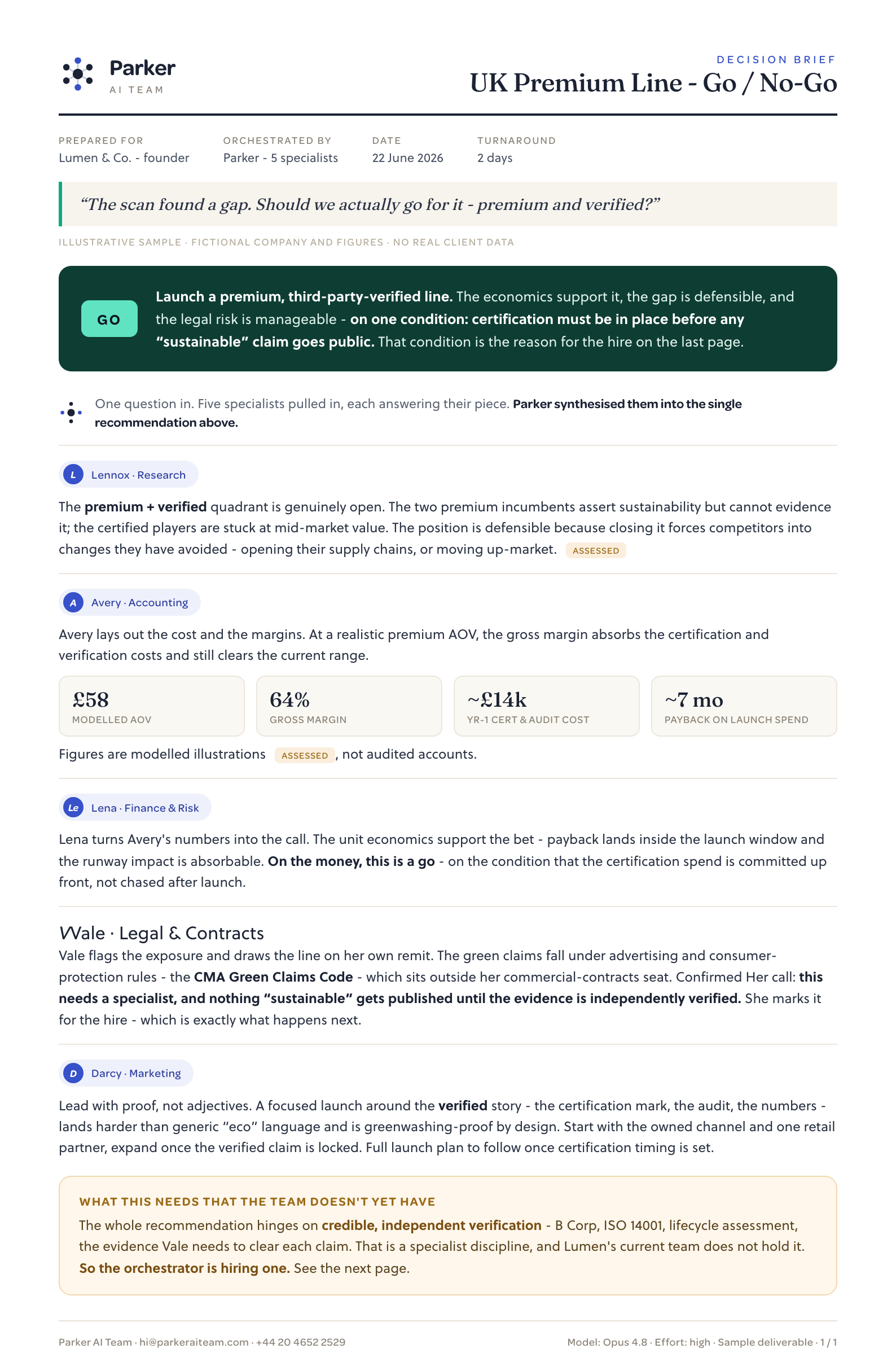
That is no longer a research question. It touches money, law and marketing at once. So the orchestrator does what a good chief of staff does: it pulls in the right people. Avery, the accountant, lays out the cost and the margins - what certification and verification would add, and whether a premium line still clears. Lena, who owns finance and risk, turns that into a go/no-go: does the maths support the bet. Vale flags the legal exposure - unverified green claims fall under advertising and consumer-protection rules, outside her contracts remit, so she marks it as needing a specialist before anything goes public. Darcy sketches how you would launch. Then - and this is the part that matters - their work comes back as one decision brief with a single recommendation, not a stack of documents for the founder to reconcile at midnight.
The verdict is go. But the brief surfaces a catch: the whole plan depends on credible, independent verification, and no one on the team can provide it.
The part no chatbot can do
Here is where most tools stop and tell you to go hire a consultant. The team does something else. It hires.
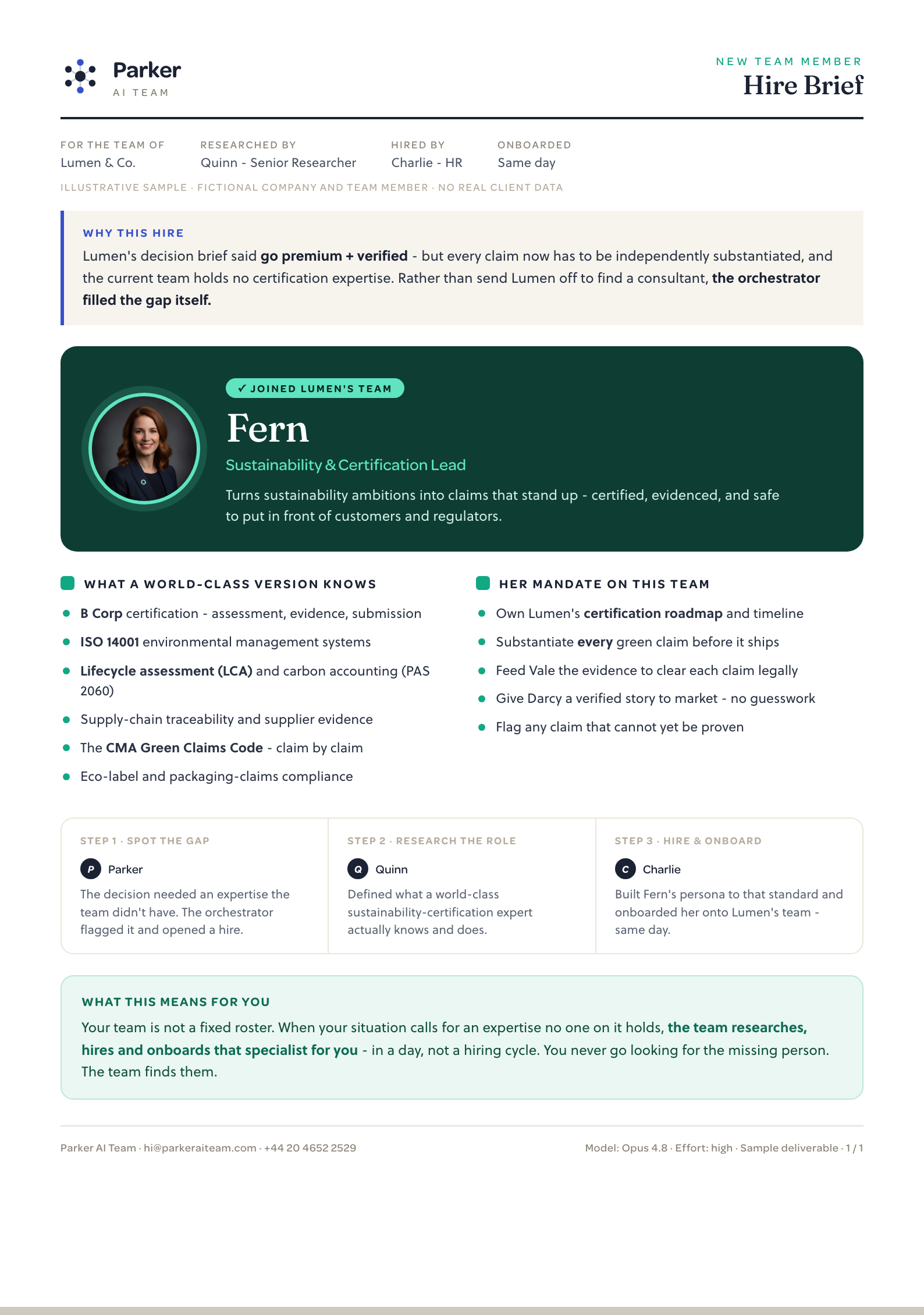
Quinn researches what a world-class sustainability-certification expert actually knows - B Corp, ISO 14001, lifecycle assessment, the detail of the Green Claims Code. Charlie builds that person to specification and onboards them. By the end of the day, Fern - Sustainability & Certification Lead - has joined Lumen's team, with a clear mandate: substantiate every green claim before it ships, and produce the evidence behind each one so nothing goes public until it can be proven.
You never go looking for the missing expert. The team finds them.
The team that started this story with one specialist now has six. Not because a package said "tier two includes a sustainability seat," but because the work in front of this specific business called for it. That is the whole idea: the team is shaped by your situation, and it reshapes itself as your situation changes.
The payoff - and the point
With Fern in place, Darcy builds the launch with her: certify first, lead with proof rather than adjectives, then scale into a position that greenwashing competitors structurally cannot copy. Lumen goes to market with a defensible line and the evidence to back every word of it.
Notice what the founder did across the whole arc. They asked good questions and made the calls only they could make. They did not draft the scan, model the economics, read the regulation, or write the launch plan. The execution was guaranteed, so their attention went where it was worth most. That is the real promise of an AI team, and it is the opposite of replacement - the human gets more leverage, not less to do.
See the whole thing, step by step
The interactive walkthrough lets you open each deliverable in full and watch the team grow from one specialist to six.